
A whitepaper on the high-level steps to build a strategy map faster and sharper. AI does the research and pressure-testing. It never gets to author the strategy itself.
The job I actually burn AI’s time on
Last time I attended a strategic planning session, people were discussing next year’s budget and which initiatives to fund. This session wasn’t strategic planning; it was about establishing financial controls. Dr Roger Martin defines strategy as the set of choices about where to compete and how to win. Those choices come at a deliberate cost: the other options you could have chosen instead. Sadly, this confusion between strategic objective setting and financial planning is common across many parts of UK Plc. In these circumstances, people assume the organisational strategy is implicit. Everyone assumes they already know the enterprise’s objective and purpose. Yet if that assumption were true, why would we have a strategy execution gap? Why would portfolio planners, IT and Finance Directors talk about aligning investments with strategy? And why do we have AI initiatives that fail to increase organisational performance?
Building my own map
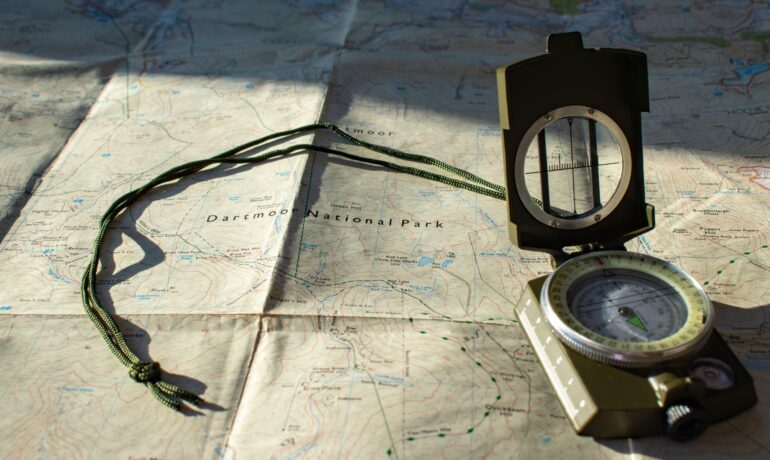
As an AI consultant, I have been looking at applications that go beyond a chatbot or robotic process automation. I have been exploring a Digital Twin to build enterprise agility, but I’ve hit a wall of unclear strategic objectives. As an ex-Boy Scout and Mountain Leader, I’m used to using a map to create direction. So I set about building a map with AI. It gives senior leaders, planners, and employees a shared definition of organisational strategy. I built it by combining internal and external documentation with established strategic tools. Leaders can use this map to sense the need for directional change and to spot where the organisation needs to adapt.
This paper sets out, at a high level, how I use AI to build a strategy map. It covers the Strategy Choice Cascade, the Business Model Canvas, the Wardley Map, the Value Proposition Canvas, the Reason-to-Buy Map, the Operating Model Canvas, the Value Creation Model and the Brand Equity Pyramid. It isn’t a paper about handing strategy to AI. It’s a paper about where AI earns its place helping leaders build the map. And it’s a paper about where organisational strategy demands AI stay firmly on the sidelines.
The job AI is actually good at here
Strategy mapping involves two very different kinds of work, and it’s worth being honest about which is which. There’s the judgement work: deciding where to play, arguing about how to win. And naming the one thing AI itself must never touch. A room full of people with skin in the outcome has to test that judgement, and no model can do it for them. Then there’s the legwork underneath that judgement. It means pulling together what’s already known about a market, a competitor, or a customer segment. It means drafting a first pass at a canvas so the room isn’t staring at a blank page. And it means checking a claim someone just made in the room against the evidence sitting in a shared drive.
That second category is where AI belongs. It’s fast at synthesis and tireless at cross-referencing. And it doesn’t get precious about a first draft being wrong, which matters more than it sounds. A blank canvas intimidates a room into vague answers. A flawed first draft works better: put it on the screen and tear it apart, and you reach a sharper answer faster. Arguing with something specific is always easier than inventing something from nothing. Furthermore, AI can scan the marketplace, identify and analyse competitors’ actions, evaluate customers’ actions, and outline the need for adaptation.
The high-level steps
1. Feed it the baseline before the workshop, not during it
Before I open a Business Model Canvas or a Wardley Map with a client, I point AI at whatever the organisation already has. That means previous strategy decks, board papers, customer research, competitor filings, analyst notes, and transcripts of earlier conversations. I ask AI for a first-cut draft of the canvas, built strictly from that material, and I ask it to flag every claim back to its source. Nobody trusts that first draft. But all of it is useful, because it means the workshop opens with something to react to instead of something to invent.
2. Use it to widen the room’s view of the landscape, then narrow it yourself
On the Wardley Map in particular, AI is genuinely useful for surfacing where a component actually sits on the evolution axis. It shows what’s still genuinely novel, and what three vendors the room has never heard of have already commoditised. I ask it to research the landscape broadly. Then I bring that research into the room as an input to argue about, never as the map itself. The room still decides what’s worth building in-house and what’s worth buying off the shelf. AI just makes sure nobody makes that decision on a partial view of what’s actually out there.
3. Let it draft the Reason-to-Buy chain, then make a real buyer test it
The Reason-to-Buy Map builds on the definition of the corporate brand. It’s the one place in the whole sequence where a claim has to survive contact with a specific, named alternative a specific, named buyer would otherwise choose. AI gives a decent first pass at drafting that chain, especially where a Value Proposition Canvas already exists to draw the pains and gains from. But I never let a drafted Reason-to-Buy claim stand unchallenged. I put it back to the room with one test: would a real buyer in this segment actually say this, in these words, about why they chose us? If nobody in the room believes a real customer would say it, it’s not a reason to buy. It’s just a hope dressed in AI’s confident prose, and that’s exactly where this goes wrong if you let it stand.
4. Use it to check the map for gaps, not to fill them silently
Once you have a first pass at the map, I ask AI to check it for internal consistency: does every Revenue Stream on the Business Model Canvas trace back to a named Value Proposition? Does every Reason-to-Buy claim have a Proof that actually points back to something real in the Value Proposition Canvas? Does the Value Creation Model’s delivery stream look, on paper, capable of honouring what marketing is promising? These are exactly the questions a tired room stops asking by hour three of a workshop. They’re also exactly the questions AI never gets tired of asking. What it flags, a person decides. It doesn’t get to patch a gap itself quietly.
5. Put it to work as the Sensing Loop once the map is live
A strategy map is a snapshot, and it starts decaying the moment the workshop ends. This is where AI does its most valuable ongoing work: not in the room building the map, but afterwards, watching it. AI scans behavioural data, competitive movement, unstructured market signals, and macro shifts continuously. AI flags when a Reason-to-Buy claim looks like it’s drifting out of date, or when a Wardley component has moved further toward commodity than the map currently shows. It escalates a signal to a named person, but it doesn’t get to rewrite the Segment Grid on its own authority, no matter how confident the signal looks.
6. Name, once, what AI is never allowed to decide on this map
This is the step that has to happen before any of the above, not after. Somewhere in How to Win, before AI touches a single canvas, I ask the client to name one thing. What’s the one thing about the way they win that AI must never quietly undermine? It might be a fairness commitment, a brand promise, or the visible presence of a human expert at the point a customer actually experiences the business. That line goes into the cascade in the client’s own words. Every use of AI in every step above sits underneath it, not the other way round.
Why this order matters
Get this backwards, and the workshop suffers in a specific, predictable way. Hand AI the whole first draft of a strategy map with no boundary named first, and the room wastes its limited time. It either rubber-stamps something that sounds plausible but nobody actually tests, or it throws the whole thing out and starts again because nobody trusts where it came from. Neither outcome is worth the time saved.
Do it the other way round. Name the boundary first, let AI do the legwork under it, and have a person test every claim that reaches the page. Then the room gets back exactly what a workshop is for: time spent arguing about the choices that decide whether the strategy actually wins. Not time spent hunting for a market figure that should have taken two minutes to find.
The map that comes out the other end is still entirely the room’s. It’s built faster, against a wider set of evidence than any one person in the room could have gathered alone. And nobody ever hands it over to something that can’t be held accountable for the answer.
If you’re building a strategy map and want a hand getting AI to do the useful part of that work, I’d be glad to talk it through. That means keeping AI away from the choices that are actually yours to make.
For further information, please get in touch with Beneficial Consulting.
Jonathan Ward
Beneficial Consulting Ltd
36-38 Wigmore Street, London W1U 2BP
www.beneficialconsulting.co.uk
Mobile: +44 (0) 7802 884598